The Tudors and Stuarts
Henry VII — Peace and Stability
After winning the Wars of the Roses at the Battle of Bosworth Field (1485), Henry Tudor became King Henry VII. He married Elizabeth of York, uniting the Lancaster and York families. The Tudor rose — a red rose inside a white one — symbolised this new unity. Henry strengthened central government, reduced the nobles' power, and built up the monarchy's money.
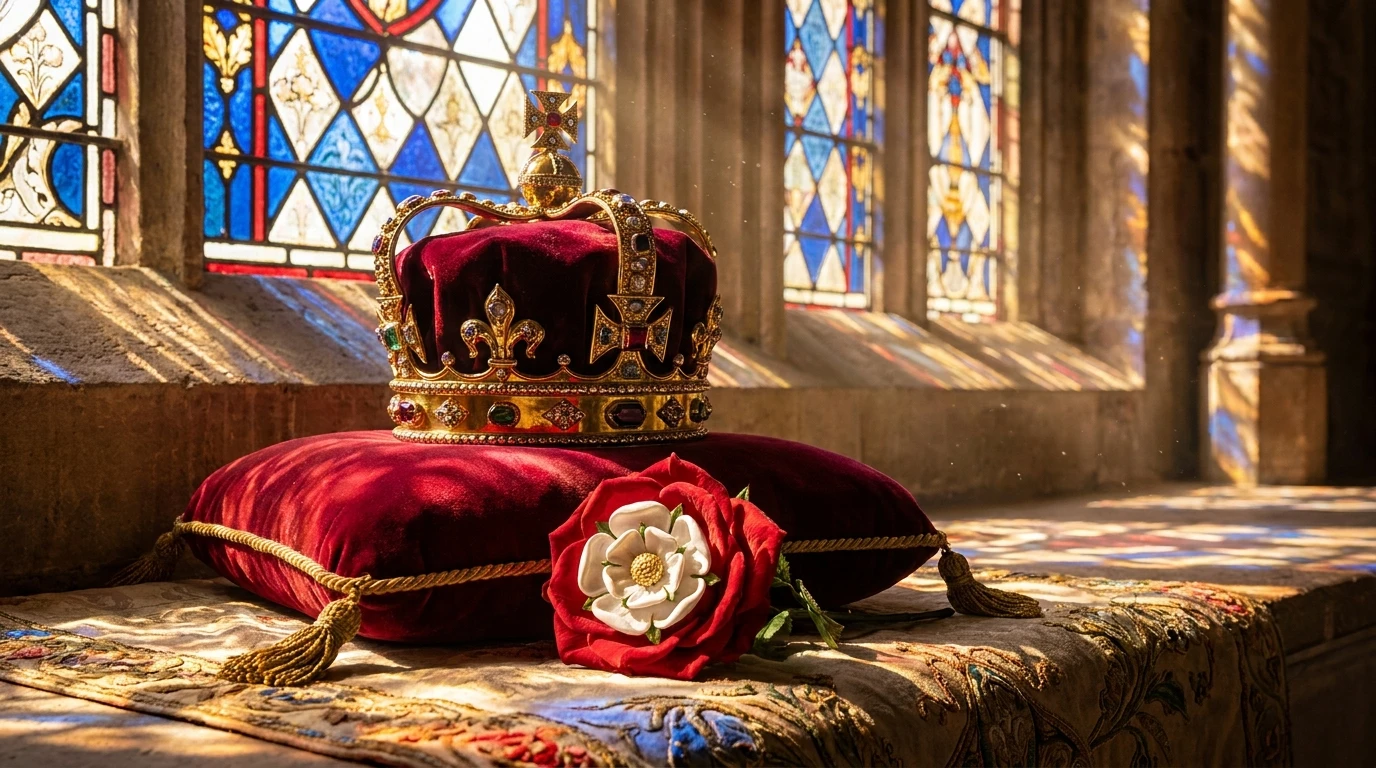
The Tudor Rose
The Wars of the Roses were fought between the House of Lancaster (red rose) and the House of York (white rose). Henry Tudor of Lancaster won at Bosworth Field and married Elizabeth of York, creating the Tudor rose — a red rose with a white rose inside.
Henry VIII and His Six Wives
Henry VIII is the most famous Tudor. He married six times because he desperately wanted a son to inherit the throne:
- Catherine of Aragon — Spanish princess, mother of Mary. Henry divorced her when she could not give him a son.
- Anne Boleyn — English, mother of Elizabeth. She was executed at the Tower of London.
- Jane Seymour — gave Henry the son he wanted (Edward), but died shortly after childbirth.
- Anne of Cleves — German princess, married for political reasons, soon divorced.
- Catherine Howard — cousin of Anne Boleyn, also executed.
- Catherine Parr — widow who survived Henry and married again.
The Break from Rome
Henry wanted to divorce Catherine of Aragon but the Pope refused. So Henry created the Church of England — now the king, not the Pope, appointed bishops and controlled church affairs. Across Europe, the Reformation was challenging the Pope's authority. Protestants read the Bible in their own language and believed personal faith mattered more than church rituals. These ideas spread through England, Wales, and Scotland.
Wales United with England
During Henry VIII's reign, the Act for the Government of Wales (1536) formally united Wales with England. Welsh representatives sat in the House of Commons for the first time, and the Welsh legal system was reformed.
Edward VI, Lady Jane Grey, and Bloody Mary
Edward VI was Henry's son — only nine when he became king. He was strongly Protestant. The Book of Common Prayer was written for the Church of England. Edward died at 15 after just six years on the throne.
Before Edward died, he tried to stop the next heir — his Catholic sister Mary — from becoming queen. He named his cousin Lady Jane Grey as his successor. She ruled for only nine days before Mary took the throne. Jane was later executed.
Mary I was a devout Catholic. She reversed her father's religious changes and persecuted Protestants, burning nearly 300 at the stake. This earned her the nickname "Bloody Mary." She also died after a short reign.
Remember
The Tudor monarchs after Henry VIII were: Edward VI (Protestant), Lady Jane Grey (9-day queen), Mary I (Catholic "Bloody Mary"), and Elizabeth I (Protestant).
Elizabeth I — The Golden Age
Elizabeth I, daughter of Henry VIII and Anne Boleyn, became queen in 1558. She re-established the Church of England and found a balance between Catholics and extreme Protestants, avoiding serious religious conflict. She never married — she was known as the "Virgin Queen."
In 1588, England defeated the Spanish Armada — a huge fleet sent by Spain to invade England and restore Catholicism. This was a defining moment of Elizabeth's reign.
Mary Queen of Scots
Scotland was strongly influenced by Protestant ideas. In 1560, the Scottish Parliament abolished the Pope's authority and established a Protestant Church of Scotland (the Kirk).
Mary, Queen of Scots was a Catholic. She fled to England after being suspected of involvement in her husband's murder, giving her throne to her Protestant son James VI. Elizabeth I kept Mary prisoner for 20 years and eventually executed her for plotting against the throne.
Shakespeare and Exploration
The Elizabethan period was a time of growing patriotism:
- William Shakespeare (1564-1616) wrote his greatest plays — Hamlet, Macbeth, Romeo and Juliet, A Midsummer Night's Dream. He is considered the greatest playwright of all time. The Globe Theatre in London is a modern copy of the theatres where his plays were first performed.
- Sir Francis Drake helped defeat the Spanish Armada and was one of the first to sail around the world in his ship, the Golden Hind.
- English settlers began colonising the eastern coast of America.
Shakespeare's Legacy
Shakespeare invented many words still in common use. Famous lines include: "To be or not to be" (Hamlet), "A rose by any other name" (Romeo and Juliet), and "All the world's a stage" (As You Like It).
James I and the Union of the Crowns
Elizabeth never married and had no children. When she died in 1603, her cousin James VI of Scotland became King James I of England — the Union of the Crowns. Scotland remained a separate country but now shared its monarch with England and Wales. James commissioned the King James Bible (Authorised Version), a translation still used in many churches today.
James and his son Charles I believed in the "Divine Right of Kings" — the idea that the king was appointed by God and could rule without Parliament's approval. This caused huge conflict.
The English Civil War
Charles I clashed repeatedly with Parliament over money, religion, and power. He tried to rule without Parliament for 11 years. When he tried to impose a new Prayer Book on Scotland, a Scottish army invaded England.
In 1642, civil war broke out between the Royalists (Cavaliers, supporting the king) and Parliamentarians (Roundheads, led by Oliver Cromwell). Parliament won. Charles was executed in 1649 — the first time a king had been publicly executed.
Britain Becomes a Republic
After Charles I's execution, England declared itself a Commonwealth (a republic). For the only time in British history, there was no monarch. Oliver Cromwell ruled as Lord Protector until his death in 1658. His son Richard could not control the army or government, and people began asking for a king again.
The Restoration and the Glorious Revolution
In 1660, Parliament invited Charles I's son back from exile. He became King Charles II — the Restoration of the monarchy. Charles learned from his father's mistakes and worked with Parliament. During his reign:
- The Great Plague (1665) killed thousands in London
- The Great Fire of London (1666) destroyed much of the city, including St Paul's Cathedral
- Sir Christopher Wren rebuilt St Paul's and many churches
- The Royal Society was formed to promote science — its early members included Sir Isaac Newton (gravity) and Sir Edmund Halley (comets)
- The Habeas Corpus Act (1679) guaranteed that no one could be held prisoner unlawfully
Charles II died without children. His Catholic brother James II became king and tried to give Catholics more power. Parliament worried he would make England Catholic again. They invited James's Protestant daughter Mary and her husband William of Orange to take the throne. James fled to France without a fight — the "Glorious Revolution" of 1688.
The Jacobites
Supporters of James II were called Jacobites. They tried to restore the Catholic Stuart line in later rebellions, including the 1745 uprising led by Bonnie Prince Charlie (Charles Edward Stuart), which ended at the Battle of Culloden in 1746 — the last battle fought on British soil.
William and Mary signed the Bill of Rights (1689), which confirmed that the monarch could not raise taxes, keep an army, or suspend laws without Parliament's agreement. This was the beginning of constitutional monarchy — the monarch reigns but Parliament rules.